
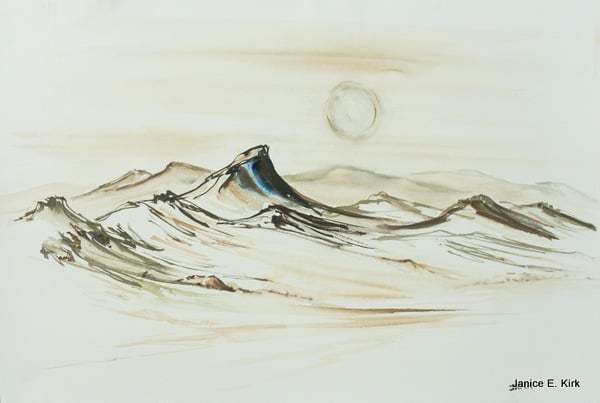

Death Valley Moon
(Note the Brush Strokes on this Painting)
Question: I want to start painting again, but as soon as I set out paints and paper, I freeze up. I’m so afraid I’ll make a mess of it.
Answer: I agree. That blank page stares at us. We have an idea for a picture but will the first brush stroke be the right amount of color in the right place? How about the next one, then the next one? Will this be a success or a waste of paper?
What to do? Build confidence by going back to basic skills. Those are the first things you learned about handling the materials and tools. Let’s start with brush strokes.
Gather up several large sheets of blank newsprint, or other disposable paper that will lie flat on a waterproof surface. Choose something you can cheerfully throw away when you are done. On your palette prepare a puddle of paint, using a medium-sized watercolor brush. Dip the brush in the paint and stroke a line across the paper. Left-handers work from right to left, right-handers work from left to right. Paint a line of waves across the paper, followed by more waves, one line large, the next smaller. Fill the page. The idea is to feel the flow of the brush across the paper. Brushwork is all in the hand, in the arm—even the shoulder is involved. Move the whole arm freely; work large. There’s no perfection here, just practice. Like the waves on the ocean, none are quite the same. It should feel free, and it should feel good.
After a pageful of waves, try making circles, a series of ‘O’s’. Can you paint a perfect circle in one stroke? Skilled painters can do that, but of course only after much practice. Practice flow patterns: parallel curving lines, ripples, waves, spirals, branching, meanders. Practice cursive letters that require a flowing stroke or a bit of calligraphy. Try grass blades or flower petals in one stroke. How about fern fronds—no retouching—just keep the repetitive strokes going up one side of the stem and then up the other side.
While you are busy practicing these strokes, you will relearn how much water you need in the brush to move the line a certain distance across the paper. You will automatically adjust the amount of color to suit yourself. You will remember how to handle the brush in different positions. You are also reminded how to handle the water; you will see the effects of colors that run, thick and thin strokes, the puddles that form, etc.
Such a simple skill yet it is one that transfers to applying paint on your planned picture. Use these exercises as warmups the next time you paint. Ten minutes of warmup exercises will get you in shape for the fun part—painting that one–of–kind picture that only you can produce.