

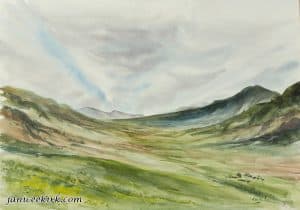
Great Basin Valley South of Ely, Nevada
Part 3. Sky Island Topography and Art
In my previous Blog I described the scene that inspired the painting and the cloud formation*** I collected the day we drove towards what is now Great Basin National Park. In the Great Basin the mountains are often termed “sky islands”, surrounded as they are by the ocean of sagebrush. Some ranges rise to high elevations. Campgrounds are few and limited in size. Over the years we visited several, and Don usually caught fish in the creeks. We also enjoyed the aspen groves and piñon pine trees that are native to the area. Ponderosa pine forests can be found in upper elevations.
Depending on available water sources, the long, sloping valleys (basins) in between the mountain ranges remain the province of grazing cattle. From early ranching days into the 20th century, overgrazing wiped out most of the native grasses and ground cover. In recent years, however, much of it has been restored. It’s an ongoing project and satisfying.
Fascinating as the science is, however, when this artist drives over the Sierras and down into the Great Basin, it’s all about space. When we pull off the road into a viewing area, the sky is BIG, a nearly overwhelming immense bowl positioned over us. The land mass is just that—an enormous mass—solid, rocky, contoured, rugged, carved earth that has been shaped by wind, water, earth movement, and human activity. To me there is a certain grace to the shape of these basin and range contours, the mountains slope to the desert in wave form, the valleys reveal old lake level markings on the distant hills. The vista is grand; the geologic history is grand. The light is all–encompassing, becoming brilliant by mid–day and forming high contrast shadows in the cliffs, ridges, and canyons. That bright light, the drying wind, and the shifting temperatures cause me to reach for hat, sunglasses, and a long–sleeved shirt. Raw exposure to the elements can be wearing, and yet a wake-up call. I’m alert to the pungent smell of sage, the breeze that wafts through the rabbit brush and sage, the flushing of a hidden cottontail rabbit that bursts from the desert shrubbery. My questing spirit comes alive, looking and listening for more. Silence and solitude are at hand, and space seems to expand before me as I watch from here beside the truck.
The three elements that all artists work with—space, mass, and light—are right in front of me; this is where all art comes from. It is easy to see in the desert with pared–down vegetation and exposed land forms. As artists we can abstract and manipulate these elements in our work, but we cannot forget why they are here. They are stage and support for life. A thriving desert life inhabits this Great Basin. Established within the limits of arid conditions, the life communities live out their own meaning and purpose: making the earth home, living in the light, thriving in the space. It’s beautiful. The scope is awe inspiring. I sense the wholeness, the unity that holds it together, and I am lost in wonder.
I’m glad I brought my paintbrush.
……………………………………………….
Where can you go to experience that sense of wonder?
………………………………………………….
*** The Cloud Collector’s Handbook, by Gavin Pretor-Pinney (https://www.chroniclebooks.com/) (San Francisco: 2011) p. 46. A great book for sky–watchers.
……………………………….
Did you know there is a Cloud Appreciation Society? I understand the attraction; I love to watch clouds. This group hopes to fight the banality of ‘blue-sky thinking’. What a concept. (www.cloudappreciationsociety.org)
……………………………………….
Painting: Great Basin Valley south of Ely, NV, 36×24 watercolor print on unframed canvas, @1980, Artist: Janice E. Kirk.