
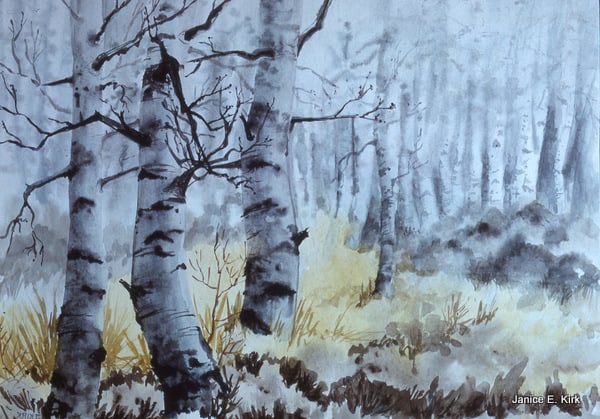

Aspen Forest in the Fog, CO
Sabbatical painting: . . . I move to another good spot to work near a stand of aspen. Their characteristic black scars contrast vividly against their smooth white trunks. Some knots and scars in the bark are from damage caused by animals or storms. The theatrical gestures of lower branches beg to be drawn. What artist can resist? . . . Aspen leaves flutter in the slightest breeze and whisper to me as I sketch . . . (Excerpt from: The Road to Beaver Park, p. 36.) *
Part 1. Aspen Lore
On the lookout for anything interesting we wandered the roads of the San Juan Mountains during our Sabbatical summers. We watched for blooming wildflowers, wild edible plants, beautiful landscapes, places to explore, and fishable creeks. At higher elevations the aspen were plentiful, whole forests of them, and they were always an enchantment. Young trees looked like slim poles reaching for the sky, but older trees reached plenty of girth. Over time, weather had pushed and pulled at them; animal and human behaviors helped re–shape the poles. Trunks developed curves and bends. Mature trees had thrust out angled limbs, all gesture and dramatic form. Black marks decorated white bark, a stunning attraction in the forest.
I had unlimited time to observe—to walk around the trees, touch, and study growth patterns. I took note of basic structures of leaf, twig, branches, bark, trunk, and how the base of the tree connected to the ground. As I sketched a certain tree, I would begin to form a deeper bond, something that went beyond the surface features. Each tree had its own character. It held a story, revealed a history. It was an important influence in its own life community. My tree became important to me. I was realizing the “inscape” that Gerard Manley Hopkins described,** the unique qualities of a particular tree. It changed my viewpoint, expanded my vision, gave me a deeper understanding of nature’s ways. I grew to love the tree and the community of trees that surrounded it. I had to find a way to paint it. Read more about how this painting came to be next week in my Saturday blog.
*The Road to Beaver Park, Painting, Perception, and Pilgrimage by J. E. Kirk (Resource Pub/Wipf & Stock: 2016) http://amazon.com http://barnesandnoble.com http://Indiebound.com http://wipfandstock.com
**The Shaping Vision of Gerard Manley Hopkins by Alan Heuser (Archon Books: 1968), p. 23.