

Quaking Aspen. Part 1.
Park me next to an aspen grove, and I’ll be happy the rest of the day. At higher elevations in the West, these handsome trees display smooth white trunks with coal black markings. Lower branches extend with dramatic gestures that give the tree distinct personality. Leaves quiver in the slightest breeze, thus the name Quaking Aspen. Everywhere the artistic attraction is the same—aspen beg to be drawn. Whenever I see one, I have to take a second look.
My bond with aspen begins in the late 1970s when we find ourselves wandering the roads in the Warner Mountains of northeastern California. New to the area, we stumble across an old campsite bordered by a shallow creek. It is surrounded by aspen, and we agree: this is the place. It’s child-friendly, private, and perfect. Marmots watch from a rockfall as we set up our big tent. We shore up the handmade camp table someone left here and clean out the well–used fire pit. The children gather twigs and sticks for a campfire. At the base of the rockfall spring water trickles from an old pipe, filling a small pool lined with mossy rocks. It’s obvious this has been a much loved campsite. We name our camp Marmot Springs.
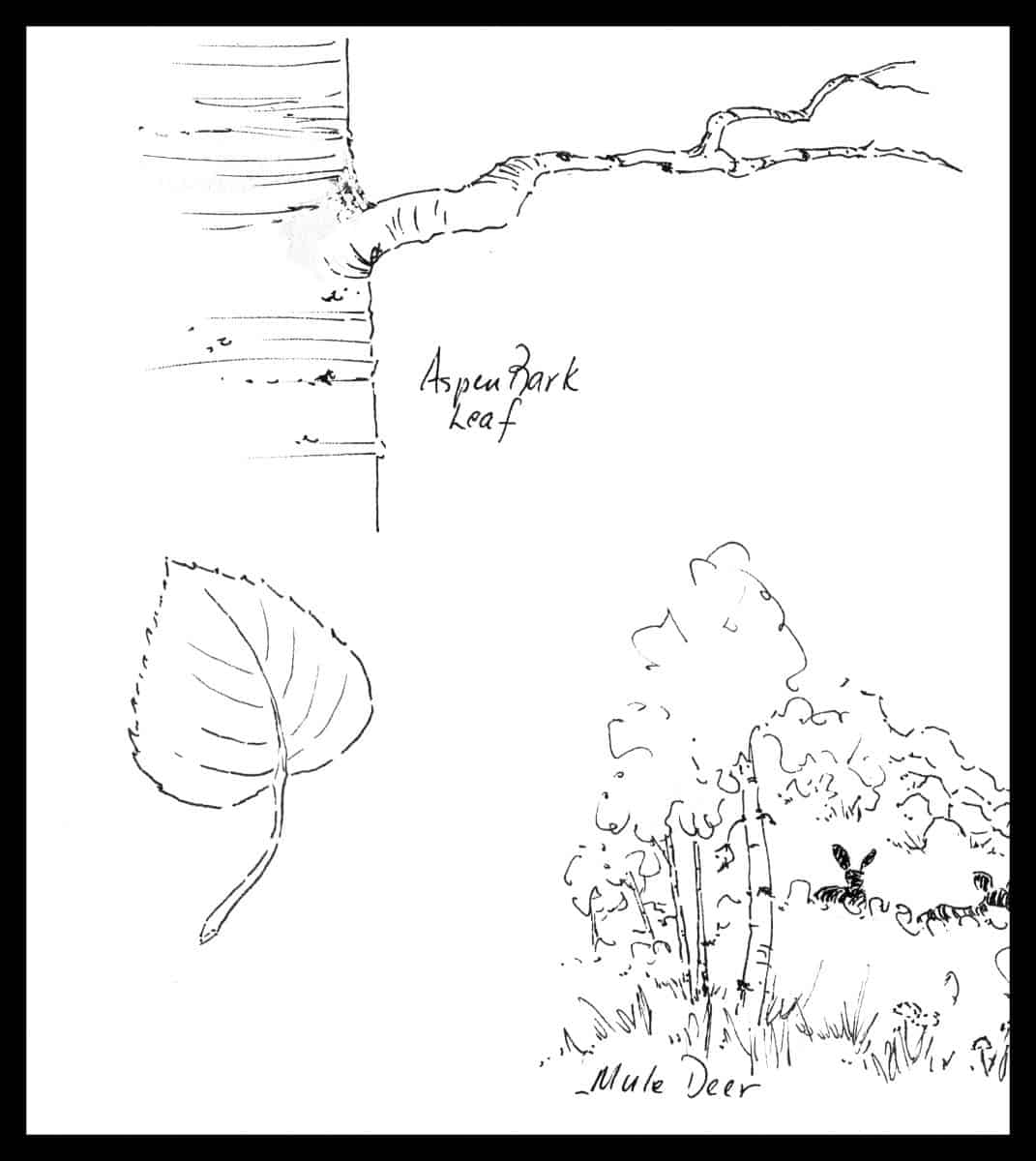
The first morning in camp Don takes the children for a nature walk up the creek while I finish camp chores. Close by our 9×12 wall tent stands a small group of 4 or 5 aspen. I walk closer to the trees to study the form and gesture. The aspen trunks look clean and white, but on closer inspection I discover the bark is not perfectly smooth. Wrinkle–like growth rings circle the trunk and cause bumps on the outside edges. I also find the white trunks are not pure white but can be a faint yellow, or more often, what I call a pale aspen green, especially the newer bark. I walk around the trees, looking at every side. I note that black splotches on the aspen are not random but are scars from old branches, now gone, probably due to weather or abrasion by animals. Branches sprout forth at regular intervals along the trunk, a growth pattern conditioned by environmental factors.
The base of the tree is heavily damaged, but the bark has healed with coal black, rough, warty growth. Leaves are thin, circular, green above, pale silvery-green beneath. In autumn they turn to gold, a sight that’s on my yearly bucket list of autumn colors. The trick is to start looking in late summer, since at higher elevations temperatures cool early and trigger the color change…