
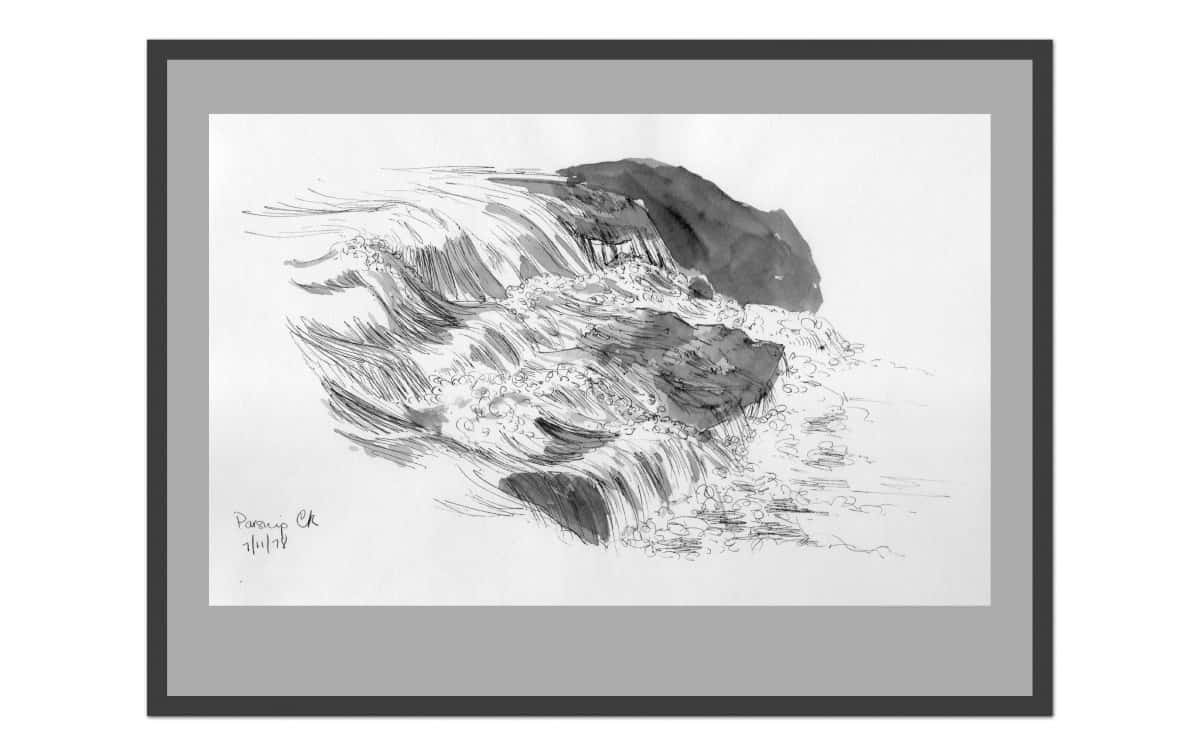
Parsnip Creek, Part 2
The day is typical of mountain summers–cool in the morning, warming in the afternoon, clear sky with that California blueness, alight and vibrant at about 6500 ft. elevation. The open forest is fairly easy to walk through, the trees interspersed with drying grasses, clumps of sage, and rabbit brush. In sight are wildflowers: red clusters of Indian paintbrush, Wyethia with its broad fuzzy leaves and yellow, daisy-like blooms, a few dandelions and stray miniatures hidden in the grass, and yellow monkey flower that thrives by the creek. The forest is a mix of Ponderosa pine, aspen, Lodgepole pine, white fir, and Douglas fir. Grey lava rocks are scattered throughout. Rough and angular, some display patches of lichens, but near the water, moss smooths rough edges.
I steady my stool amidst rocks and pine needles in a semi-flat grassy area that’s in the shade of a Ponderosa pine. I need the shade to avoid the glare of white paper in the sunshine. I open my drawing pad and scan the scene before me. How do I see something in motion and immobilize it on paper? Where to start? I have my own approach, not exactly traditional. I prefer pen, ink, and a bit of watercolor paint. To begin I may dot with pencil the location of key areas, but for me, the images go faster with a little brushwork first. So I pick up my brush and stir a drop or two of creek water into the small glob of charcoal grey watercolor I have squeezed onto a 3 inch metal saucer. The saucer I borrowed, with permission, from my daughter’s camping doll dish set. Small, durable, unbreakable, this little saucer travels with me on every sketching trip. I brush a bit of charcoal grey onto the page, indicating the stationary elements first–the dark rock on the other side of the tumbling stream, the flat rock almost mid-stream at the lower level of the fall, the boulder right at my feet. Thinning the color to a lighter grey, I shadow in hints of the dark rocks behind the flow of water–curving the strokes, shaping waves, placing diagonals where needed to show the angle of curve and flow. It’s like putting the infrastructure in place first, something to hold the water shapes…