

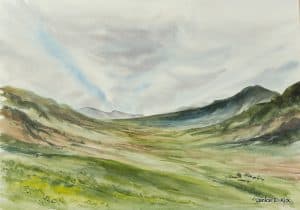
Great Basin Valley South of Ely, Nevada
Art Show dates extended:
Sixteen paintings from The Road to Beaver Park, Painting, Perception, and Pilgrimage
remain on view at Winona Public Library, Winona, Minnesota,
through November 30.
Part 2. Tips and Useful Techniques
In my previous Blog I listed the art supplies that I carried along on my Plein Air odyssey. That was a wonderful year of camping and painting. Here I answer questions from readers:
✔Did I stretch paper while camping? Small sheets I just clipped to the board. For large sheets, yes, soaked paper in lakes and streams if there was a clean spot. Mostly I sponged it like crazy to soak it; then taped the paper to a large board with gummed tape, and laid it flat in the sun to dry.
✔Did you work on large sheets in camp? Yes, sometimes. I commandeered the bunk in the pickup camper. I used larger brushes and set out paint in an enamel pan. Fun.
✔How about colors? The sage, junipers, conifers, rocky outcrops and distant mountains challenged my color sense. Western outdoor colors are more muted, more earthy than student colors, which were not right for Western outdoors. Different vegetation and geology require different shades (for example, in Oregon: Viridian, was the perfect green for much of that plant cover. I have never used it anywhere else.)
✔My palette evolved to 3 primary colors that were very different from my student colors : Prussian blue, cadmium red, raw sienna. I mixed Prussian blue with the cadmium red to get a wonderful Paynes Grey. Then I found that a mix of Prussian blue with raw sienna produced a beautiful forest green. For other colors I added: Hookers green lt/dk, Windsor purple, charcoal grey, cadmium yellow med/lt, gamboge yellow (the perfect color for ripened wheat), and alizarin crimson. When we got to the Southwest, I needed earth colors: burnt sienna, yellow ochre, sepia, Indian red.
✔How about brushes? I started out with student brushes, which were good, but I also experimented with Sumi painting that year. I loved the Sumi brushes with bamboo handles. They are now my first choice for sketching small/medium size work.
✔Did my style change? Yes. I started out inking my sketches with Rapidograph drafting pens, which I had used successfully at home for the plant drawings. On the trip, however, every time I opened up a pen, that’s when Murphy showed up, as in anything that can leak, will leak. The pens were a mess, India ink spread all over the tip and inside the pen cover. Very messy for camping. That ink got all over everything, and it is permanent. I cleaned them up, but after several occurrences, I finally put them away. I surmised it was changes in altitude that caused the leaking. We were frequently going from 4000–9000 ft elevation in the Rockies. Months later Hugh Cabot, a Tubac, Arizona artist, recommended the Pentel Rolling Writer with permanent ink. They were great. I loved them. Unfortunately, they are no longer available. I ordered some from Amazon in recent years, but they were not the same.
Over the 15 months my style evolved from very detailed, controlled work, (you can see that in some of the drawings in the book) to freer and at times more abstract, sometimes atmospheric work. I experimented with media: pastels, Sumi painting, different drawing materials, casein paints, but the media had to travel well, dry fast, and be easy to handle and store. Watercolor won out, as well as the previously mentioned Rolling Writer ink pen and of course, pencils. More next week: Why I painted In Spite of Ticks and Other Annoyances . . .