
 Part 2. The Drawing Lesson
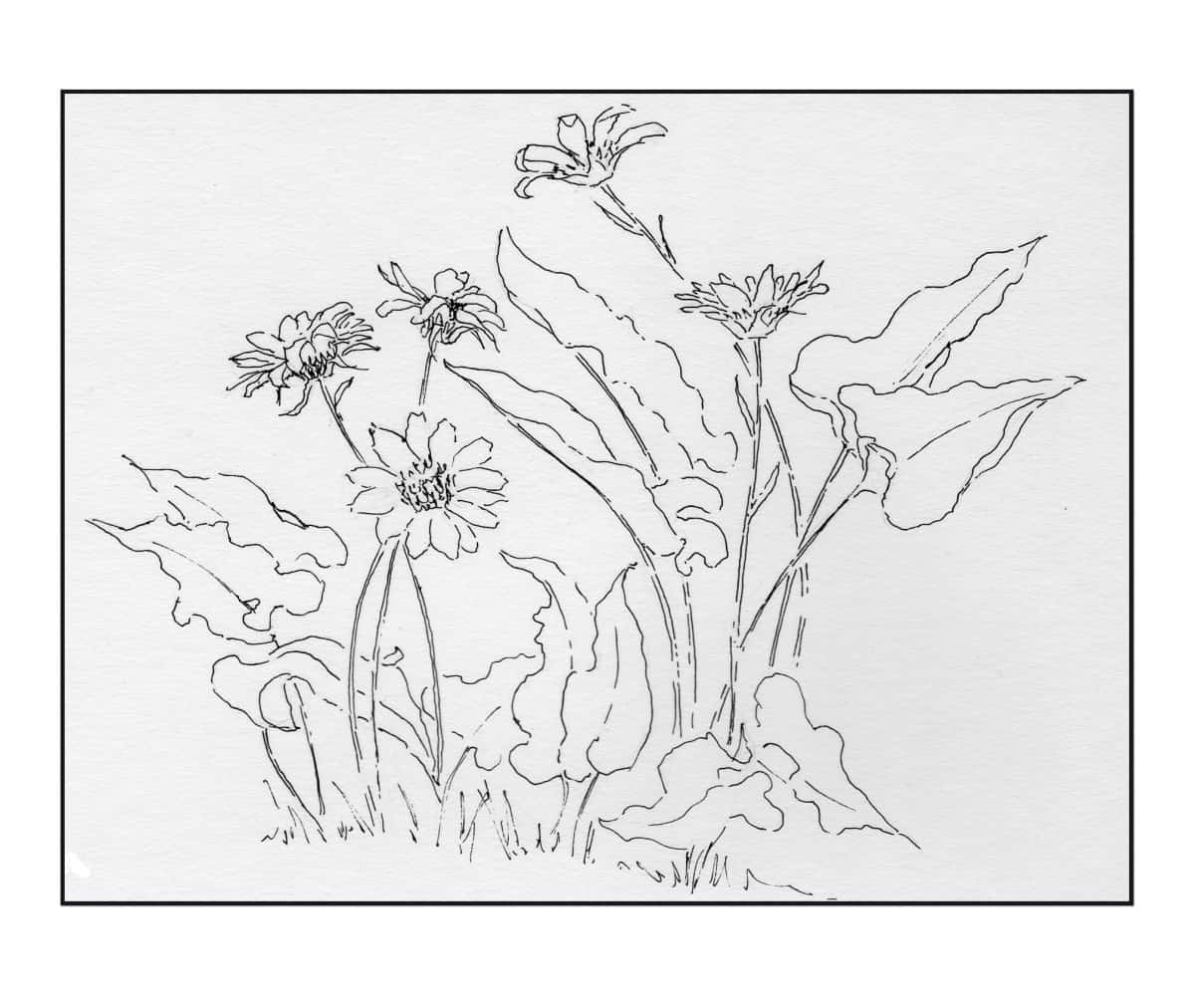
I walk around the clump of Balsamroot to find the best angle for drawing. When I sit down to sketch, I take a careful look at each leaf shape and stem line, noting how the plant parts are grouped. Basic plant structure generally falls into two categories: (1) stems that flow in an uninterrupted line from bottom to top, usually with a slight curve; (2) or stems that are segmented, each section is clearly obvious and each may be angled in a slightly different direction. In this case the stems curve upward from grass-covered roots, a pleasing arrangement that most likely puts leaves in optimum positions to catch sunlight. Showy and cheerful, the yellow flowerheads also turn toward the sun.
I pick up a 6H hard drawing pencil, which gives a very light, clean line. I plan to ink directly over the sketch, and light lines can easily be erased when I am finished. I draw the grouping of leaves and flowers, paying careful attention to every aspect of the plant. I want this to be accurate enough for field identification. It is a pleasure to sketch the curving stems, mimicking the graceful lines that offer a certain gesture to the placement of leaves and flowers. I draw light circles to center the flowers; the petals will fit into that when I add more detail. I note how the flower head sits on the stem, the special way it connects, the tiny leaves that branch from the flower stem, and I mark down the number of petals. The ground leaves twist and turn in different directions, like youngsters seeking their place. I look carefully at exact shapes and lines of leaves, so that I can get the perspective right. Some project towards me, others fall back, most of them point either to my right or left. Each leaf has a noticeable long vein that extends from the stem connection to the tip of the leaf. In places the leaf edge is folded over or slightly curved so that a small portion of the back side shows. I draw both edges of the shape.
I am into drawing mode now, concentrating so closely on the plant that I don’t see leaves and flowers anymore. Instead I see shapes, lines, edges, contours, gestures, and note the negative space between the actual objects. Negative space has its own shape.
It is not a good idea to talk to an artist when they are in drawing mode, which is a right–brain process. Verbal exchange interferes with visual concentration. I might not even hear what someone says until my thinking shifts focus from right–brain images, perceptions, and concepts to left–brain words, numbers, analysis, and other information. Learning to draw is learning to shift focus into right-brain mode. Anyone can learn to make this shift, and once a person learns to see in this way, they never forget. Drawing techniques are not as important as learning to see the artist’s way…to be continued.