
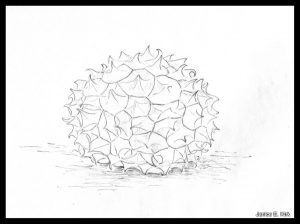
Star Puffball (Calvatia sculpta)
Part 3. Puffball Lore
In my previous Blog I sketched with pencil the amazing configuration of a geometric marvel in the form of a white puffball. While I take a break I wander across the road and up into the woods. Maybe I can spot another one. I love these open woods. The carpet of pine needles crunches underfoot, very resilient, almost spongy. I step between lichen–decorated dead twigs and branches, past a lava boulder or two lying in the dry grass, and take note of several young pine trees making a healthy start. Close beside a ponderosa pine I see another white form pushing up from the forest duff. It is small and rounded, a different kind of puffball.
Some puffball species grow as large as a soccer ball. Their structure is different from a mushroom; puffball spores are contained inside the mass. When mature, the spores turn into a brownish powder. At that stage any small impact, even raindrops, on the outer covering can cause it to disintegrate, and spores will “puff” out in a small cloud. Step back, it’s not wise to breathe the spores, as they can be irritating to respiratory passages.
Are puffballs edible? Generally speaking, yes, but identification is the key. When small in size like this one, they can resemble poisonous mushrooms, so I would want to be sure of the species. One type of Amanita mushroom, which is very poisonous, in its embryonic stage has a superficial resemblance to this puffball because it also has a pyramidal wart-like surface. Although the two are usually found at different elevations and in different seasons, it’s best to learn how to tell them apart. Pay close attention when you find one. When properly identified, a puffball can be treated like a gourmet mushroom and can be cooked in similar ways.
I prefer to leave the puffballs right where they grow, on the ground, doing their important work. They are decomposers, which means they break down wood and organic matter into basic components. These nutrients are deposited right back into the soil where they are available to nurture new plant life. What would we do without them? Without fungi organic debris would be accumulating everywhere. Imagine the smell and the mess.
Fungi are essential to a healthy forest, a thriving eco-system. In some areas of the Northwest mushroom hunters invade the woods en masse during the season. Without instituting limitations, the forest can be trampled, harming roots, and tree growth. The supply of natural fungi is easily exhausted, to the detriment of forest life. We must take care to love our forests without overwhelming the natural systems.
Read more next Saturday when I write about finishing my drawing.