
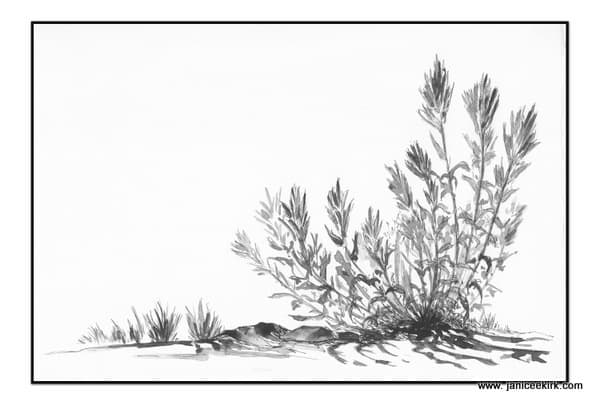

Part 2. The Drawing Lesson
In my previous blog my love of wildflowers leads me to sketch an Indian Paintbrush. I wait until afternoon to sketch so that I can sit in shade. I set my art stool in the grass next to a stand of Ponderosa pine on the edge of the clearing. From here I can keep an eye on the children below. The shallow creek is ideal for building dams and launching twig boats on a stretch of current. What could be better than that?
The red color of the Indian paintbrush is eye-catching, but my initial sketch will be a grayscale drawing using brush and pen. I love to work with black and white gradations for a basic study of the form. Without the distraction of color, grayscale isolates shapes and structural patterns, beautiful in their own right.
I pull out my small paint pan, which holds a dried dab of charcoal gray watercolor. My favorite brush for this kind of work is a Sumi brush with a bamboo handle. The bamboo is straight–sided, which encourages a certain way to hold the brush that incorporates the use of the whole arm in the stroke. This connected movement transfers to a looser, freely flowing stroke of paint. I like the effect, and the movement feels good, almost lyrical, like a dance move. The brush holds a fair amount of water, yet the brush hairs taper to a fine point, which is useful for details. I carry small, medium, and large brushes, but I use the medium size for almost everything.
Before I begin the brushwork, however, I find my 2H drawing pencil and quickly outline stems and flower heads, placing the plant image in a somewhat dramatic position on the lower right of the paper. This is one spot that encompasses the “golden ratio” area of the paper. That’s the sweet spot for artistic design, when all areas of the composition appear to be in optimum balance and perfect ratio. Also called the “golden mean,” the proportion is a fascinating mathematical study for those so inclined, but for me it is more intuitive, a sense of what feels right. Artists of every kind explore and work with this aspect of beauty. For example, the composer, Rachmaninoff, referred to and worked toward “the point” in his music. Musical structure of a piece builds towards such a “point”, where the proportion is perfect, the ratio is satisfying, balance has been achieved. For him, finding the point was not only dependent on musical structure, but also influenced the way he would perform the work.**
I walk back down to the creek to scoop up water in my water can. A few drops on the paint pan, and the dry color comes to life. I mix a light gray color, then using the finest tip of the Sumi brush I outline the stems. To the eye this wildflower is a very busy plant. The stems curve outward from the base, forming a bowl–like shape that is cluttered with leaves. Narrow and grasslike, some leaves divide into narrow segments.
The flowers are in a dense cluster at ends of stems, technically called branches. The flowers are tubular and yellowish green, some tinged in scarlet, and are somewhat hidden inside the colorful red bracts. Bracts, which are often mistaken for blooms, are the modified leaves at the base of the bloom. Usually bracts are small, but in this case they extend well beyond the blossoms. I brush darker gray to indicate the intense red color at the tips of the plant. The upper leaves may be as red as the bracts. I pick up a lighter gray on my brush to dab background stems and leaves. I pause a few moments to let things dry, then stroke medium hues for the nearer stems in front. I add dark leaves in front to increase the three–dimensional effect. The darker lines and forms visually pull the image closer, while the lighter shapes recede. Next week I will finish the sketch and find out what a garter snake eats for dinner. . . .
**Schonberg, Harold, The Great Pianists (Simon & Schuster: 1987)