

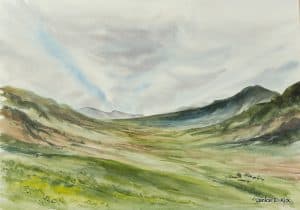
Great Basin Valley South of Ely, Nevada
In my four previous Blogs, I discussed my strategies on painting outdoors, En Plein Air. Here I present a new way to look at the finished product, a landscape painting.
In his book, Beauty in Photography,** Robert Adams said, “Landscape pictures can offer us three truths—geography, biography, and metaphor. . . Taken alone, geography is sometimes boring; autobiography is frequently trivial; and metaphor can be dubious. But taken together, as in the best work of artists, the three kinds of information strengthen each other and reinforce what we all work to keep intact–an affection for life.” Adams also wrote that, “Gardens are strikingly like landscape pictures, sanctuaries not from, but of truth. . . ” A statement to ponder, and to use.
Geography is a record of a certain place, a specific location, a setting. It contains details of terrain, vegetation, geology, and particular characteristics of place. Biography is the subjective aspect: who is behind camera, who is holding the brush? It’s a personal matter, a private view of selected forms, shapes, contours, light and shade, spatial elements, etc.
Metaphor carries the significance, the meaning, moments of revelation for the viewer. It might be rediscovery of something quite different from the artist’s viewpoint. We may re-evaluate where we find ourselves. What is our sense of place? Do I see it that way? What is the particular meaning, significance for me? Are these lasting images that connect to the heart? That ring true with your inner artist? A special resonance? Have you found a kindred spirit?
Take a look at the painting above. Try to identify the geography (Great Basin), the biography (I held the brush), and metaphor (Artist’s intent? Your opinion). What do you see? Does it resonate in any way? Note the sweep of desert, the expanding space, the colorful vegetation, the smallness of the ranch buildings. Does this convey any personal message or idea to you? A memory? A feeling of peace? A wish to be there?
With all these things in mind, enjoy your next museum tour. And don’t stop there. Pick up a simple child’s watercolor set (spend the extra money for a Prang or other set that has intense colors) and maybe an extra brush—a Sumi brush—and a watercolor pad, or maybe a journal notebook, or a 10x magnifying glass to look at small things. Venture outdoors and take a close look at nature’s treasures; choose you own images; discover the mysteries of outdoor life; then go back and take another look.
You’ll never view the natural world in the same way again, and you may discover like I did that being outdoors is a necessary grounding for daily life.
**Adams, Robert. Beauty in Photography. Aperture Foundation, 1996. Essays in Defense of Traditional Values.