

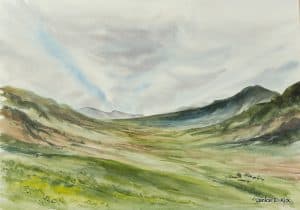
Great Basin Valley South of Ely, Nevada
Part 4.Useful Techniques
Last week’s Blog described helps and hints for painting outdoors, and reasons why I kept going out there. I wish to add that after twenty years of enjoyment, trial and error, and lots of practice, I came to rely on certain techniques:
1. The washes that we learn to do first in watercolor classes. They are super important for skies, water, large spaces, even small spaces like barn walls. Practice, practice, practice to get them smooth and even. They are good warm up exercises too.
2. I now practice brush strokes to loosen up: On newsprint or other throwaway paper, brush large circles, waves, calligraphy strokes, flower petals, grasses, etc. Brushwork is all in the hand, the arm, the brush.
3. To produce a glow or increase color intensity, use layering. Build up shades of color one on top of the other. Let them dry in between, of course. Also, for aspen glow, you can prep the white paper by brushing a thin yellow wash over the whole sheet to start with; let it dry, and it becomes an undercoat that affects everything you put over it. What we are trying to do here is to get refractive colors (sunlight coming through, think rainbow) onto a flat surface that will be reflective color (sunlight bouncing off the page). Not easy, but skillful layering works.
4. It’s a given: Drawing helps the brush work. Drawing a lot, helps the brushwork a lot.
5. For atmospheric effects use lots of water, pale tones of color, fuzzy detail. Less is more.
6. I discovered Flow Patterns, the visual patterns found in elements that flow. Those simple patterns made a difference in the way I painted objects in nature. I had to account for them; I had to make sure I rendered them accurately in order for my painting to look “right.” (See Blog of 07/29/2017 for full description)
As you have already surmised, learning to paint is a lot of fun, but in order to become good at it, it takes practice. That’s a plus too, because the practice is a lot of fun. We are not only training the eye, we are also training the physical movement of hand, arm, and shoulder. We are practicing the coordination required to work on a whole sheet of paper at one time. We are learning to handle the amount of water in the brush, the amount of pigment needed for a certain spot. It’s a happy balance of eyesight, time, and energy. Enjoy!
Read more next week on A New Way to Look at Landscape Paintings.