
Death Valley had a superbloom this year. I wish I had been there!! In 1977 we stayed a whole month and did see plenty of wildflowers, but not as many as this year. From what I read Death Valley had three significant rains last October, as much as 3 inches in some locations. That set the seed for the superbloom. It’s all in the timing, and of course, the amount of moisture. Some seeds wait for years for just the right conditions.
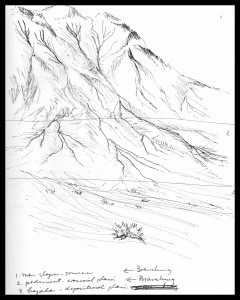
This old sketch shows marvelous erosion lines from top to bottom of this mountain. The lines across the sketch indicate my Park Service geology lesson for that day. The top section of the mountain is the source of the eroded material, the middle section is the erosional plane called the pediment. Runoff materials are deposited on the bajada, the alluvial plane which fans out onto the desert floor. Most of the flowers we saw were situated on alluvial planes in various locations, and of course the desert floor. Desert gold blooms were at their height when we were there. Desert Gold is a large yellow flower with a flowerhead similar to a daisy. A favorite of mine was the desert five-spot, a delicate pink flower with five deep burgundy spots around the center. Sand verbena, golden evening primrose, purple Notchleaf Phacelia, Paintbrush, Globemallow, and Desert chicory are other flowers we found. Blooming starts at lower elevations in the south of the park. As they fade and temperatures rise, the blooming gradually moves further north in the park, as well as up into the higher elevations.