
Part 2. Drawing a Giant
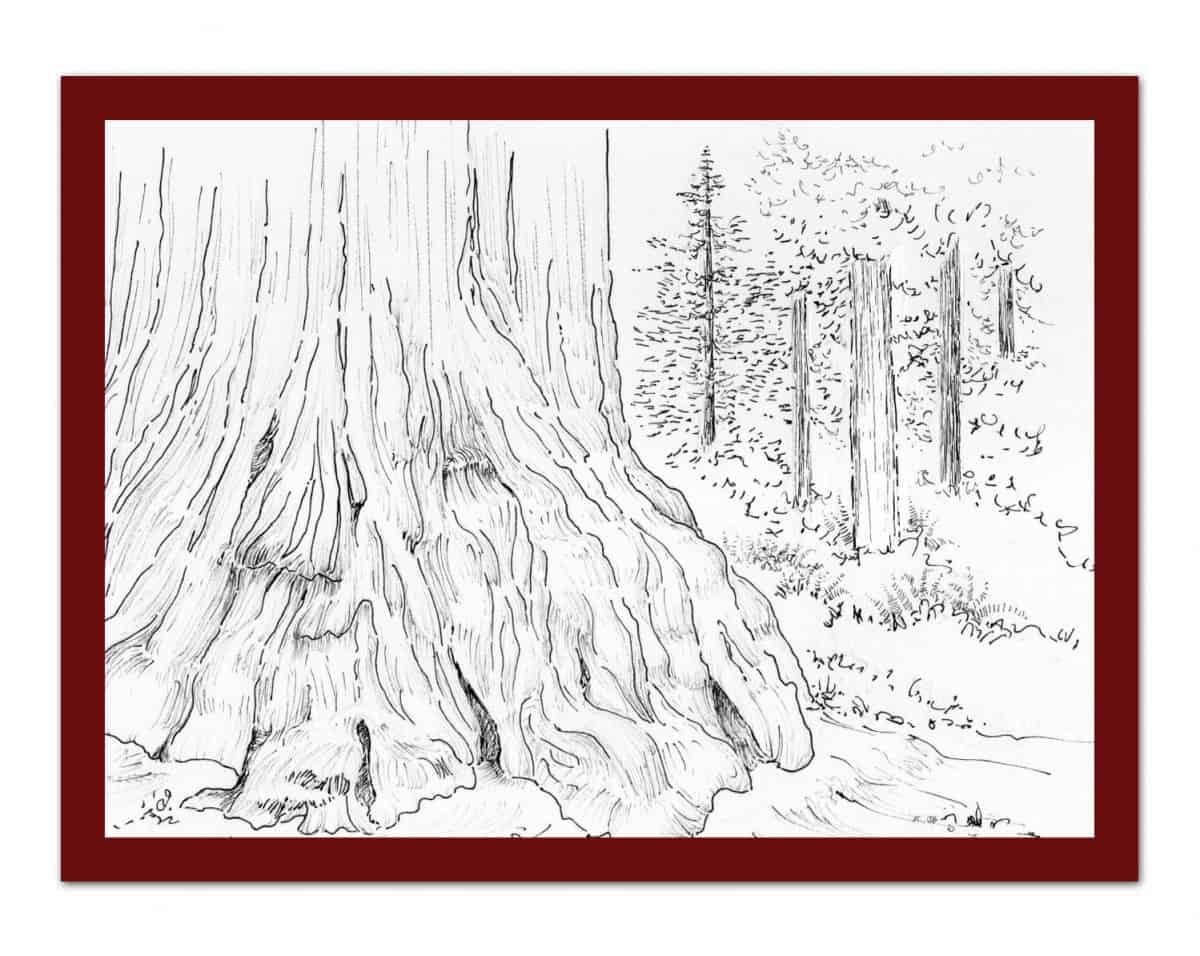
At length I wander off by myself to find a place to sit down and get serious. The grandchildren stick with Don, who is leading them on a Nature Trail walk in search of a banana slug. I head the other way and stumble into the park amphitheater, a beautiful open space hewn from dense forest. I pause to catch my breath, and that’s when I spot my subject, an enormous redwood near the edge of the clearing. What fascinates me is the base of the giant: a growth of lumpy, gnarly wood that rises from sturdy roots and serves to buttress all sides of the giant trunk. I must get that gnarly base on paper. I unfold my art stool, reach for my sketchbook, and begin.
Using pencil, I lightly sketch the right hand side of the trunk and base. Since I draw with my left hand, it is easier and better to work from right to left on a drawing. The opposite is true with right–handers. The hand moves more rhythmically, and the drawing is safe from too much rubbing. I gauge with my artist’s eye just how much of the trunk to include. If I try to do the whole width of the trunk, I’ll run the sketch off the paper. I choose to draw as much as will fit the center of the page. Then in the background I will incorporate a few forest trees to indicate the difference in scale.
As I sketch the trunk contours, I mark lumps and depressions, holes in the bark, and rhythmic downward curves. I plan how to shade the uneven surface so as to round projections and delineate the dips and holes. I put a lot of detail into the pencil rendering. The base is particularly interesting where it has established toeholds in the surrounding soil. It’s like water patterns on a beach, but the inlets and outlets are forest duff.
When I take a break from drawing, I walk around the tree and examine the duff. To my surprise, I find cones, too many to count, and so small, only about an inch in length. The fresh cones are green and tightly closed, while last season’s cones are brown, open, and dried. I shake seeds into my hand. How can such a massive tree grow from one of these tiny seeds! It’s mind boggling.
Back to work, I start inking the drawing very carefully. One wayward ink line can ruin the whole piece. To shade, I render thin parallel lines following the curves and contours of the pencil sketch. The hush of the forest aids my concentration, and gradually the trunk takes shape on the paper. I hope I have captured its strength and solid character. The background redwood trees with the typical straight–line trunks and an undergirding of ferns are quickly completed. I pack up my gear and head back to find the others…