

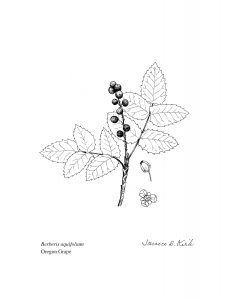
 Are you ready to sketch? Equipment at hand, plant chosen, time to get outside? The next thing is to stop, look, and listen. That’s observation. Whatever you note in your observation is a detail to put into your drawing. Observation is primary truth, basic information. No one can argue with this information. Ignore the way other artists draw. Seek your own style. Style evolves as you practice sketching; don’t try to rush it.
Here are some tips for putting those observations on paper:
Stem: Start with the stem. It centers the structure of the leaf. Smooth? Angled? Other? Indicate interior structural lines lightly to begin with. You can emphasize them later if need be.
Leaf: If the leaf is simple, sketch the over–all shape to position it on the paper. If you have a better idea, then do that. If leaf is complicated with other branching (compound?), count the connections, lightly dot the placement, then draw the side leaves into position.
Veins: Do veins of the leaf point towards the edge of the leaf? Then draw them first; they will help you position the outside edges. This is especially helpful if the leaf has 3-5 lobes or more. (palmate?)
Edges: Smooth? Follow the curves. Serrated? Count the points. Too many? Then you only need to indicate them, but if they are few in number, count the points and draw them accurately.
Nodes: What happens at the nodes? Indicate lines, angles, etc. Any blossoms or nuts? Draw them too.
Base: What happens at the base? For basal plants you might find leaf sprouts, dead leaves, even flowers. If it is growing in the garden, be sure to visually anchor your plant to the ground by sketching debris, soil lumps or curves, and such.
Look again, correct lines/shapes. Draw any markings/holes/bumps/insect damage that might be important.
Is your sketch taking shape? Keep on, keep on. Erase, then correct lines. The more you look and sketch, the better you draw; the more you draw, the more you see. Give yourself another chance, and then another, and another.
Sit back. Prop up your drawing or tape it to the fridge. Take a deep breath. Sketching time will take you a world apart. It is my hope that you find it relaxing; that you come away pleased with your efforts; and find peace in your heart. It will make the rest of your day go even better.
In my next blog I will remark on the uses of flowering plants. We can’t live without them.
Now where did I put my eraser? I want to finish this sketch.
………………………………
Lots of plant sketches to study in *Wild Edible Plants of Western North America by Donald R. Kirk, illustrated by Janice E. Kirk (Naturegraph: 1970)