

Part 2. Learn to see.
In my last Blog, I told how to get started making a Nature Sketchbook, including a list of drawing tools. Now take courage, and I’ll tell the secret to getting a successful drawing on paper.
In her book, Drawing on the Right Side of the Brain *, Betty Edwards discusses the process of looking at something and then letting the brain shift into drawing mode, which utilizes the right side of the brain. It’s something a person does every day without thinking about it. Don’t try too hard. Relax the eyes, and let them roam over the subject matter. There may be a definite shift in perception and awareness. Instead of seeing and naming a given object and verbalizing about it, the viewer notices the edges of things, the shape, contours, highs and lows, curvature, straight edges, corners, and angles. The trick is to let it happen when you draw. An artist has to be aware of configurations to render the shape correctly on the drawing paper.
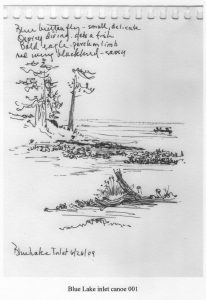
For example, take a look at the horizon and mentally line out from left to right the top edge of the trees, bluffs, houses, the top of the landscape. Then shift your vision and look at the sky, see the sky as an entity of its own. Mentally line out the bottom of the sky, seeing the shape of the lower edge of sky where it meets the earth. You just performed an obvious shift in perception. If you can notice the contours and edges of the skyline, you will find it possible to put that jagged line down on the drawing paper. Sketch slowly. Give yourself time to follow the angles/curves with your eye and then record them with the pencil. Handle the pencil lightly, don’t press too hard; keep the line sketchy at first.
A useful Betty Edwards* exercise is to take a simple line drawing; turn it upside down; then copy it. Again, in order to be successful, you have to pay attention to the shape of edges, contours, curves and dips. Voila! The image emerges.
To ease the mind, declare your first page or two scribble pages. Go ahead; make a few marks. The first try may not be what you want, but the more you look, the more you will see. The shift in vision may happen abruptly. Suddenly you are sitting back, relaxing the eyes a bit more, and looking at the outline of the object. That’s it. If you can see that outline curve and angle, your pencil can put that on paper. You have made the dramatic shift to right brain “seeing” mode. That’s the key to drawing.
Caution: the first time you try this, it may not be a huge success, but try again. Take your drawing pack out to the park, sit on a bench, and take another look. The shift may happen just as suddenly there, and what a treat to be at the park. After you have figured this out, special techniques of shading strokes, fill–in methods, or use of particular shaping lines can be learned. Most often these are added after the basic sketch is on the paper. Pick up tips from other artists by studying their drawings. Try those tips out for yourself; make those simple techniques your own.
Is this useful information? Are you ready to try this? Go forth!
*Drawing on the Right Side of the Brain (Jeremy P. Tharcher, Inc.:1989)