

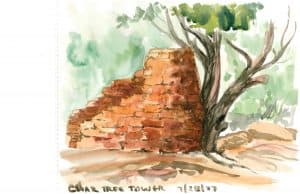
Ancient Masonry Walls Still Standing**
We drove out to Hovenweep on a whim. That was the summer we traveled from California to Colorado in our brand-new, blue, VW bus. We were headed home from Mesa Verde still enthralled with the tour of Cliff Palace, climb to Balcony House, the museum of artifacts, and the canyons that held cliff dwellings. Somewhere past Cortez going west, we saw the sign to Hovenweep, 40 miles? We checked what little brochure information we had. The name alone—Hovenweep— sounded intriguing. We had to see it.
I remember the long road through arid landscape of sage and juniper. Was the road paved all the way? I’m not sure, but I remember a lot of dust-blown miles. Hovenweep (“Deserted Valley”) is actually in Utah, the SE corner. When we drove in to the park here was the (lone) ranger at work in front of his cabin, the only building in sight. He was busily carving a thick slab of door that was set horizontally across some sort of steady base. He carved doors for locals, mostly Cortez folks. Very friendly, he greeted us with, “Welcome to my campground. Sign my book,” and pointed out two campsites down the road a short distance.
We first drove over to the pedestal holding the sign-in book and were greeted by a green collared lizard. The lizard propped himself on a rock and watched every move we made as we signed the book. He kept his distance, not very far away. When I stepped toward him he rose up on two back legs and ran, ran, ran. Hilarious.
As we climbed back into the VW, the ranger hollered, “I’ll bring you a garbage can!” We drove on down the short distance to camp. The green collared lizard followed us all the way, then proceeded to watch as we set up our camp gear on table and situated ourselves on the bedrock. That’s what I remember, bedrock; shade shelter? yes, but no place for a tent stake here.
We spent the afternoon driving to Twin Towers and the Square Tower Group and took short hikes on boulder-strewn trails. Hovenweep is an indigenous site. Human habitation goes back over 10,000 years, according to the park website: “. . . when nomadic Paleoindians visited the Cajon Mesa to gather food and hunt game. These people used the area for centuries, following the seasonal weather patterns. By about A.D. 900, people started to settle at Hovenweep year-round, planting and harvesting crops in the rich soil of the mesa top. By the late 1200s, the Hovenweep area was home to over 2,500 people.” https://www.nps.gov/hove/learn/historyculture/index.htm
We were nomads ourselves, ignorant at that time of most of the history. Even so, one could sense a certain atmosphere, a slight need to “look over my shoulder,” a sensation that felt like others had been there before. Or maybe it was the potsherds that could be found on the ground as we walked.
That trip was long ago, and why do I bring it up now? Because one thing we experienced is still with me: the night sky. I woke in the middle of the night to the star swept universe above us, breathtaking in its scope and mystery. It arched from low horizon on the left to low horizon on the right, a dome holding bright constellations, mists of Milky Way, scattered stars twinkling, blinking, and an infinite number of shining lights both large and small. Unforgettable. I had to bring it onto the page, and so I am writing a new poem: Hovenweep, 1959. You can read it when my next book comes out: working title: I Pray for the Earth.
…………………
Have you ever seen the night sky in the desert? Or maybe it was over the water of a summer lake? Or a backpack trip in the mountains where the atmosphere is so clear? If not, then put the night sky on your bucket list. Better yet, plan a trip to Hovenweep. The park is much improved these days with 31 campsites and a visitor center. Check ahead to inquire about conditions. Fill up your gas tank. Carry water. Minimal goods available. Be prepared for desert camping. Enjoy a wonderful experience.
………………….
**Sketch is from Mesa Verde in 1977, Cedar Tree Tower, to show the masonry of ancient walls still standing. Hovenweep walls were lighter in color, off-white, tan, gray neutrals.
…………………………..