

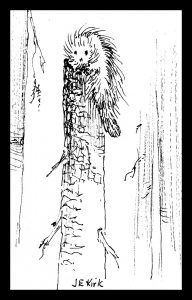
From the files of Don Kirk: …For this diminutive porcupine the tree is a poor choice.It is a stump only about five feet high. Mamma is not far up her tree when the unfortunate baby arrives at the top of its tree. The little porcupine turns this way and that, no doubt never before having to deal with a short tree. Most animal babies are cute, including this small porcupine, which begins shrilly squeaking. I walk slowly to within six feet of the baby to take a picture. The small mammal turns its back on me and raises its tail and quills, a classic porcupine defense posture. Turning its head side to side, and noisily clicking its teeth, the baby keeps an eye on me.
Although I know that porcupines cannot throw quills at you, I back off about twenty feet from both the “mamma tree” and “baby stump.” It is clear that the young porcupine is plenty upset with the short tree. The mother arrives near the top of her tree and stops climbing. Loud grunts, teeth-clicking, and screeches show that she, too, is unhappy with her baby so far below and so close to me.
A short time passes. The baby descends the stump. With quills raised it walks to mom’s tree, and expertly begins to climb. Mom, meanwhile, has already begun to descend before she realizes her baby is steadily climbing toward her. The mother fails to keep her grip on the tree and falls a few feet before she grabs hold. Her young one is still far below. The mother stays where she is, as if resting from all the excitement. I have never seen it happen, but I know that porcupines do fall out of trees, and from high up. Thirty-five percent of porcupine skeletons studied show one or more fractures. As I stand in the cool shade of a tall white fir tree, I watch the baby determinedly climbing and hope that the mother stays put. The baby reaches mom and they greet each other with quills down, nose to nose. Everything is all right now.
A glance at my watch shows that all this happened in less than an hour. I have enough fish for supper and tomorrow’s breakfast, so I head for camp.
Used by permission of Donald R. Kirk