

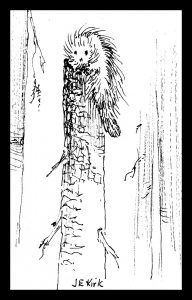
 From the files of Don Kirk: Early afternoon on the west shore of Blue Lake finds only me and two porcupines on the trail. Although these big rodents are primarily nocturnal, it is not unusual to seen them about in broad daylight. The mother porcupine and her baby are distant about 50 yards, unhurriedly shuffling toward me. Given their coat of some 30,000, needle-like quills covering their back and tail, porcupines don’t need to hurry.
I am fishing my way around the lake. Fishing has been good and supper is in my creel. I decide to see what these porcupines are up to. Moving slowly, I lean my pole against a tree, remove my creel, and sit on a log in the deep shade of the white fir grove. The porcupines have covered perhaps 20 yards and are still some distance from where I sit with my back against a tree.
The mother stops twice during her slow progress on the trail, raising her head, bobbing it slightly up and down as she sniffs the air. Porcupine eyesight is poor, but their sense of smell and hearing is quite good. Even with the formidable defense of thousands of quills, this porcupine is concerned about danger.
Other animals do prey on porcupines, notably the fisher. Adept as the fisher is at flipping over a porcupine to get at the unprotected belly, the predator nearly always comes away from the encounter bearing a few quills, and occasionally a fatal dose. Cougars, bobcats, coyotes, wolves, and great horned owls are known to prey on porcupines. A polar bear was once seen with lips and face pin-cushioned by quills. In these mountains there are no fishers, wolves, or polar bears, but the other predators are here.
Sometimes, even porcupines get stuck with another’s quills, usually during a squabble between males over a female. An unreceptive female may donate a few quills to an aggressive male which nearly always cools the latter’s passion. Fortunately, porcupines are expert at removing foreign quills from their face and body. Sitting upright, they methodically remove the offending quills using their teeth and nimble front feet.
The mother porcupine, her baby ten feet behind her, is nearing my shady resting place. Abruptly, she stops and peers about. She raises her head, sniffing the air. She seems to not like what she smells, which is probably me. I don’t want her to be overly alarmed so I slowly rise from the shady log seat and take a short step into the sunshine. She spots my movement, but the prickly critter appears uncertain about what to do next.
With a few low grunts, probably for the benefit of her youngster, she turns sharply off the trail away from the lake. With no increase in speed, she leads her offspring through the open forest. Soon she picks a tree and begins slowly climbing, uttering more and louder grunts. The baby chooses a different tree and begins to expertly climb. Baby porcupines are born fully furred, fully ”quilled,” and eyes open. Within a few hours they can climb a tree…
Used by permission of Donald R. Kirk