

From the files of Donald R. Kirk…
Part 1. Nectar Wanted.
The male calliope hummingbird hovers like a tiny helicopter only a few feet away. A couple of butterflies flutter nearby. A bumblebee is here, too. We all want something from the numerous blossoms of red columbine. I want photographs. The others want nectar. In this place on the west shore of Blue Lake a steady seep of water serves the needs of the columbine. I stand still, wanting not to disturb this scene. The butterflies and bumblebee ignore me. I move away fifteen or twenty feet, and the hummingbird goes back to work on the columbine. I remove my backpack full of photo gear and set up my tripod and camera.
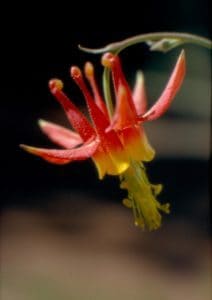
Red columbine (Aquilegia formosa) flowers produce plenty of nectar, but it is not easy to reach. Nectar collects in the bulbous ends of the five long spurs on the nodding red and yellow flowers. Although the calliope hummingbird is America’s smallest bird north of Mexico, it has no trouble reaching the nectar with its beak and tongue. One of the butterflies lands on a bloom and uncoils its long proboscis into the flower.
There are no honeybees. Their tongues are too short to reach the nectar. The bumblebee uses a different approach. Landing on a flower spur, the weight of the big bee causes the columbine blossom to droop even more. Buzzing its wings to help maintain position, the bumblebee chews a hole in the end of the spur. Inserting its tongue, the heavy bee laps up the nectar.
We might consider this unfair since it bypasses the plant’s pollination system. No pollen is rubbed off onto the bumblebee’s body to be carried to another red columbine flower. The bee is unaware of this, as is the columbine. Both species are only trying to survive.
Survival in nature has to do with adaptability…to be continued.