

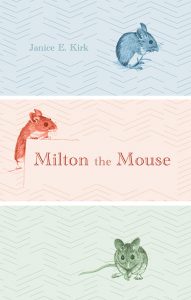
Thanks to Ken McCullough, Poet Laureate, Winona, MN, for his thorough review of my new book, Milton the Mouse:
Milton the Mouse, Janice Kirk. Resource Publications.
It is said that the family that prays together stays together. It might also be said that the family that plays together stays together—what better way to play together than on extended camping trips. The family in Janice Kirk’s Milton the Mouse, the Stewarts (stewards), goes on such trips and on these trips they explore the fauna and fauna they encounter—the father is a biologist, who also recites passages from John Milton, his “old friend;” thus, the children, Matt and his younger sister Kathleen, get to hear words from one of the consummate masters. One assumes that these words will register in their minds and will most likely be passed down to their own children when that time comes, perpetuating an appreciation for the power of words. Incidentally, regarding praying together, one might note that the author’s last name “Kirk,” is the Scottish word for “church.” To some degree, the Stewart family worships in the church of nature. The dynamics of the family are clearly established in the first chapter of the book. We experience the interchange of, father, mother, benevolent older brother, and younger sister and the scenes are almost cinematic in the way they play out.
The mother is an artist, and makes sure that Matt and Kathleen always have the materials to document what they encounter on their travels. She also functions as a kind of foil for the other family members, by presenting motherly cautions such as the fact that Milton may be a carrier of the hantavirus. The mouse from whom the book takes its title is named after John Milton, of course. Milton joins the family as a stowaway on one of their camping trips and becomes a participant in their day-to-day life. Speaking of mice, this book is not a Beatrix Potter knock-off nor does it purport to be. It puts the reader in a real world setting yet does not pander to the “consumer-gatherer” mentality, laced with video games, movie references and what passes for popular music. The only concession to popular culture is comic books. The Stewarts have healthy preoccupations such as reading and classical music and the dynamics of the family are cordial and natural—there is no dark or perplexing issue underlying the story.
Milton is identified as a white-footed deer mouse, and has mouse habits—even though he is somewhat anthropomorphized in that he understands English and is taken in by music, although most people who’ve been around wild animals often enough know that they sometimes respond to music. Milton is captivated by the music that Matt plays on piano and on his record player. Nonetheless, Milton remembers his “home”: and its environs and ultimately wants to go back to that life. The family cat Bertha is Milton’s nemesis, and Bertha acts as any cat would, looking at Milton as a potential plaything or prey-thing.
The book is entertaining, delightful and well-written. It presents an example of a family that functions in a refreshingly traditional way. It presents information on such practical issues as live-trapping and proper care of pets. Music is a thread throughout the book; in fact, the book ends with the words and music to the song “Milton the Mouse,” the words adapted from John Milton. The book has a charming appendix that includes facts about white-footed deer mice, Ludwig van Beethoven and John Milton. Milton the Mouse would be a challenge for young readers but the rewards are many. It’s also a pleasant book for adults to read to children.
–Ken McCullough, Poet Laureate, Winona, MN
…………………………………………..
Published by Resource Publications, Milton the Mouse is middle-grade fiction (ages 8-10). It is available from http://amazon.com, http://barnesandnoble.com and http://Indiebound.com Enjoy!