

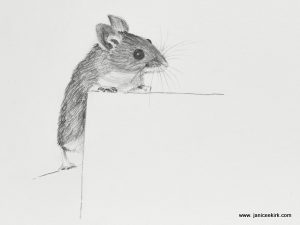
Milton the Mouse
Listened to John Milton’s poetry,
Danced to a Beethoven Contra Dance,
Loved the Moonlight Sonata.
He became a very Smart mouse!
Arts Smart. Part 7. Arts Lessons Help Students Think
In my previous blog I discussed ways to help re-set priorities to put Arts training at the top of School Budget categories. Here is more information to strengthen that position: Arts classes improve thinking skills.
How does this happen? Brain development starts with sensory perceptions of the real world. Students name and identify objects and experiences; these facts and impressions develop vocabulary. The named “truths” are based on experience, the “reality”.
Perceptual information feeds both sides of the brain. Most schools favor training only one side, the left side of the brain, which governs verbal, analytic, symbolic, abstract, rational, logical, and linear thinking. But wait—that takes student brain development only halfway. To be a whole person, using the whole potential, students need classes that train the right side of the brain. That is exactly what occurs with instruction in art, music, dance, drama, and the literary arts.
Arts activities develop the right brain. They deepen perception of the outside world, correlate learnings between subjects, and extend language. Right brain functions are nonverbal; this is the image side, the drawing side of the brain. We use it for the important work of synthesis (putting it all together), concrete learning (actual experience), reflection (to gain insight), metaphoric relationships (comparisons), spatial thinking (3-dimensional concepts), intuitive thinking that can make leaps of insight, and holistic thinking that allows us to see the “big picture”.
The marvelous connecting cable between the right and left brain, the corpus callosum, provides communication between the hemispheres. Memory and learning are communicated back and forth. When both sides of the brain function at capacity, students demonstrate an improved ability to think.
It is well known that each of us has a favorite way to learn. General categories include visual learners, who want to “see” things’; auditory learners who learn best by “hearing”; and kinesthetic/tactile learners who want to “touch, hold, or move” to learn. Arts activities in their very nature, provide all of these opportunities. This is why all students should have access to these lessons, and not be pulled out for tutoring. They may miss the particular class that will help them learn.
How do we measure progress? The usual true/false or multiple-choice tests do not fit the situation. Rather than machine grading, student progress can be evaluated in other ways: criterion/referenced tests, demonstrated skills, ability to discuss arts concepts, response to performances, improved concentration, purpose, and care in the craft. More subjective, but relevant, we can note student progress by the individual satisfaction, sense of accomplishment, and enthusiasm for the work. That’s another win-win for education.
Take a look at the following study on music lessons. It may spur you to find a music class for your child. How about doing it yourself? These teachings are not restricted to children. It works for adults too—it’s possible to re-train the brain and even increase your IQ. Besides that, it is fun and enjoyable. Do it for the fun. It will provide a break from your busy day, yes, and secretly you will know its benefits.