

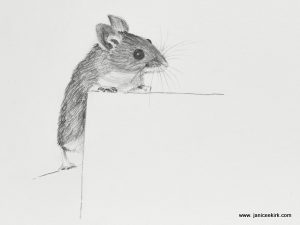
Milton the Mouse learns to love Beethoven and quote John Milton’s poetry
Milton is a very smart mouse!
Part 2. The Goes–Ins and the Goes–Outs
In my last Blog I spoke about the widely documented fact that Arts training makes children smarter. How does this happen? One way is to assist brain development at the most basic learning level: sensory perception. The arts help to refine the senses, those organs by which the brain receives information and as a result, what we do with it—what goes in and what goes out. Arts activities are an important way children learn to perceive the world more keenly; those keen perceptions in turn improve actions, products, and behaviors. We are talking about Input and Output.
Input: For all of us the everyday world is perceived through the senses. These sensations and facts are absorbed by the brain. This input to the brain is stored as knowledge. When we sharpen the input avenues, students become more aware; they see more, hear more, develop keener kinesthetic sensitivity, improve psychomotor skills, and build language in a concrete way. Arts training is the antithesis of the current trend of push-the-button and stare-at-the-monitor learning. Arts classes are hands-on, creative experiences that contribute to self-knowledge. The lessons are active: doing, creating, developing, and internalizing a more comprehensive understanding of the outside world. The information gathered is fuller, more accurate, more complete, and more in-depth. This kind of learning becomes lodged in the mind, the heart, and the hands.
Output: When on a budget we like to get our money’s worth, so it’s a win-win that Arts expenditures, in the same allotted time, and with the same efforts result in improved student output. The quality and craftsmanship of student products and live performance is better, becoming more polished and refined. Good teachers incorporate into the lessons high quality content—great literature, art, and music—so that students become familiar with the bedrock expressions of our culture. This in turn provides bridges into other cultures. Traditional art forms and great works connect with history, offer meaning, and give us moments of astonishing beauty. As well, traditional art forms offer models for students to launch new ideas and creative projects.
To the Parents: What can parents and educators do to improve the information input/output brain process? Sharpen the senses by offering Arts classes. In the schools, dance is traditionally taught in physical education classes, along with sports and psychomotor skills. In most programs, drama, poetry, and creative writing are incorporated into Language Arts units. Music and Art lessons each require a specialized teacher and suitable working spaces appropriate to the activities; just like competitive sports and PE programs need their own specialized areas and equipment. Parents, if you want the best for your student seek out the good schools that already have art and music courses in their curriculum; courses offered to every child. Outside lessons are always good, but huge learning opportunities are lost if arts lessons cannot be coordinated with classroom learnings.
In my next Saturday Blog I will tell how I was introduced to arts disciplines at home, at school, and in private lessons. Many of those creative and memorable moments coordinated with classroom lessons which enriched my knowledge and understanding. In time, they opened up career paths for me as a musician/singer, artist, and writer. Future blogs will also explore the arts as language. Stay tuned.
……………………………………….
Milton the Mouse by Janice E. Kirk (Resource Pub., Wipf & Stock Pub., 2019)
What do you do with a stowaway mouse from a camping trip? First, you have to catch him . . .
Available from http://barnesandnoble.com http://amazon.com http://Indiebound.org http://wipfandstock.com