

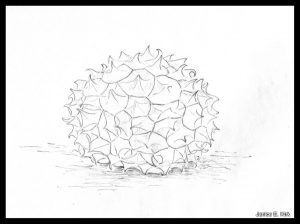
Star Puffball (Calvatia sculpta)
Part 2. Sketching a Geometric Marvel.
In my previous Blog I tell about our discovery of an amazing puffball in the middle of a dirt road in the Warner Mountains. The puffball is all geometric forms from the center to the edges, and I hope to get it down on paper by making a field sketch. I choose my hardest graphite pencil so I can be very exacting as I lay out this busy pattern. The 6H drawing pencil works well, and I lightly sketch the rounded form. I count the polygons from the center top and down the sides. They appear to be in rows; some are almost perfect forms, while others are uneven or squashed to fit the space. I’m trying to be precise, but the polygons are not even, so I roughly outline the placement of the rows as best I can. As I near the lower perimeter of the form, the perspective gradually changes. From my viewpoint the rows get closer together until the outer rows with their pointed tips are positioned in silhouette, making the globe appear prickly, even though it is not prickly at all. It is somewhat soft and leathery to the touch.
To fill in the drawing, I start with a middle polygon, where I can see a full shape. It happens to have six sides, a hexagon. I rough it in, and from there I work upward and downward, adding more hexagons, sometimes a pentagon or other figure, whatever I see. I leave the interior points in each polygon for last.
This puffball is not easy to draw. The pattern is very busy, with the pyramidal peaks leaning every–which–way, and lots of them. After a long session I stand up to stretch my legs and give my eyes a rest from such concentration.
My location is above our camp and from this vantage point I can look down across the meadow and see the family, the spring, and the aspen grove. Don and the children are building a bird blind. They found a lot of downed aspen poles to use. On our last trip to Cedarville we picked up a big roll of binder twine to tie the poles together. The project will no doubt require a lot of Boy Scout knots as they tie the poles into a quasi–fenceline and then set them upright.
We will all enjoy the bird blind. Every morning we have watched a flock of white-crowned sparrows, juncos, and other small birds come to bathe in our spring, but they are easily scared away. With the bird blind we can observe undetected, and Don can get close-up shots.
Read more in my next Saturday Blog as I take a break and look for more puffballs.