

LEARNING TO SEE:
In general flowering plants grow one of two ways: a basic structure that is linear or segmented. We start with Linear structure.
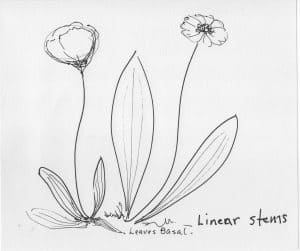
LINEAR STRUCTURE: A linear flowering plant has a stem that grows in one uninterrupted line from ground level to top. If there are leaves, they emerge at the base of the plant or may be found at the top of the stem. The leaves are usually, but not always, linear in line and structure. Leaves growing from the base are called “basal”. If there are blossoms, they grow either at the base or top of the plant. Check my sketch, or better yet, find a linear plant to observe and draw, perhaps in the garden, or use a clear photograph?
Observe the linear stem: Is it straight? Curving? Which way?
Stem: Is it smooth? Rough? Odd texture? Hairy? Just a few or many? Round? Square (mint)?
Observe the leaves: what shape? Oval? Elongated? Heart-shaped? Triangular? Other?
Leaf: Veins: linear? How many? Parallel? Do they come to common point? Do all veins start at the base of the leaf? Do all veins end at the tip of the leaf?
Leaf: Outside edge: smooth? Serrated? How many points? Stickers?
Leaf: surface: Is it smooth? Hairy? Healthy? Damaged? Dried areas? Flat? Curling? Marked in some way?
Observe the blossoms: rounded? Pointed? Cluster? Bell-shaped? Umbrella-shaped? Other?
Blossom: colors? Basic hue? Variations?
Blossom: how does it attach to the stem? Very thin connection? Wider belt? Cupped?
Blossom interior: simple pistil/stamen? Complex? Lots of little blossoms? Other?
Observe other features: berries? Seeds? Other?
Take a walk in the garden or the park and look for plants that have linear stems. Tulips, wild-flowers like shooting stars, hostas, some ferns–it’s like going on a treasure hunt. Sit and sketch your plant. Try not to pick it or damage it in any way. Look closely and observe every feature. The more you notice, the easier it is to draw because you have more information and you continually judge the proportions and details. Having fun? Tell you observations to an interested party–your children? a neighbor? other family? Show off your knowledge by sharing. The more you see, talk, and observe, the more you will see. Maybe they will want a drawing pad and pencil too. Enjoy!
In my next blog, I will give the observation list for segmented plants. Stay tuned!