

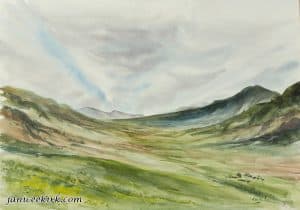
Desert Valley South of Ely, Nevada
Sabbatical painting, 1976: . . . from boulders by the side of the road to whole mountain ranges that rise dignified and implacable, the contours unfurl as the road winds through them . . . the hollows of valley and canyon depths are filled with space that extends in all directions, boundless. It fills the immense bowl of the sky from horizon to horizon and beyond . . . (Excerpt from: The Road to Beaver Park, p. 15.**)
Part 1. Space. It’s all about space.
Traveling Highway 50 across the middle of Nevada can be daunting to the urban traveler. The first time we traversed that road I felt daunted. That was about 1961 when we headed for Lehman Caves National Monument for a summer job. Gas stations and towns were miles apart. Long stretches of grassland and sagebrush carried us from one mountain range to another. The slow pull to the top of mountain passes seemed endless.
The next trip across that Basin and Range Province I knew what to expect, so the seeming emptiness didn’t seem as empty as before. By the time we drove it on sabbatical year, I realized I was looking at the landscape differently. I focused not so much on the roadway, but looked farther, scanned the wider distances. The ongoing views literally expanded my vision. The distance held my attention. Mountain ranges began to seem like extended wings, not in a static way, but in a welcoming way.
I don’t mean to overly romanticize that drive. The desert is still the desert. Conditions can be harsh at times, and the traveler needs to be prepared for emergencies. One early (1960s?) exploring trip into the middle of Nevada found us camped by ourselves overnight near the remains of a long–forgotten homestead. This was not good planning on our part. It was a dry camp, but we did carry water and gasoline. That evening a gusting desert wind, part dust-devil, propelled us into the truck for shelter, then came flying ants, followed by local poachers in the night. We didn’t sleep much and left pretty early in the morning. Our inexperience was showing that night, but we were reassured to know that we carried the right equipment and tools. After that we planned better and sought out safer places to camp.
By 1976 when our Sabbatical trip rolled around, we were more sophisticated with our gear and rig. Don had field experience with photography and nature lore. I had experience enjoying en plein air (in the open air) sketching and painting. We had more camping know–how and so did our two children. Not all of our itinerary was new territory. We included known places on our way to exploring new areas. One favorite was Lehman Caves, which later became Great Basin National Park. (See Chapter 3 of The Road to Beaver Park** for our Lehman Creek camping adventures.) On my next Saturday Blog I’ll tell you more about getting there and what caught my eye for this painting.